Chief Isaac's People of the River - Historical Accounts

Chief Isaac's People of the River
Home
The Chiefs
The Isaac Family
Stories
Historical Accounts
Photo Album
Traditional Territory
Culture and Religion
Language
Books and Reference


Historical Accounts

The Fur Trade The Klondike Gold Rush
Discription of Chief Isaac Chief Isaac's Trip to San Fransisco
Captain Ferdinand Schmitter Account of the Chief Tappan Adney's Description of a Traditional Camp
Chief Isaac Crosses the Great Divide Isaac fought for Canada, and the Tr’ondek
Charlie Isaac Went To War - Served All Over Europe Civilization? Take it Away!
Dawson Daily News Accounts

The Fur Trade

In 1867 Russia sold Alaska to the United States. The subsequent arrival of American traders brought the fur trade directly to the Han when the Americans established several trading stations in Han territory. The first was Fort Reliance, built in 1874 by the Alaska Commercial Company six miles below the mouth of the Klondike River, across from the Han village of Nuklako. According to Francois Mercier, who was the impulse behind the creation of Fort Reliance, the station was opened at the insistence of the Han chief Catseah, a leader of the Tr'ondek Hwech'in (or Klondike) band of Han. (Source: HAN people of the river, Craig Mishler, William E. Simeone)

The Klondike Gold Rush

It was the Klondike gold rush that brought thousands of gold seekers to the Klondike region beginning in 1896. This made the Han people a small minority of some hundreds of people, compared to the hundred thousand invaders. The leader in those difficult times was Chief Isaac. He resisted the destruction of the traditional ways, opposed against the destruction of the natural resources, especially against overhunting the caribou herds and the destruction of the forests.

Chief Isaac quoted in Dawson Daily News, December 15,1911.
"All Yukon belong to my papas. All Klondike belong my people. Country now all mine. Long time all mine. Hills all mine; moose all mine; rabbits all mine; gold all mine. White man come and take all my gold. Take millions, take hundreds fifty millions, and blow'em in Seattle. Now Moosehide Injun want Christmas. Game is gone. White man kills all moose and caribou near Dawson, which is owned by Moosehide. Injun everywhere have own hunting grounds. Moosehides hunt up Klondike, up Sixtymile, up Twentymile, but game is all gone. White man kill all."

Discription of Chief Isaac

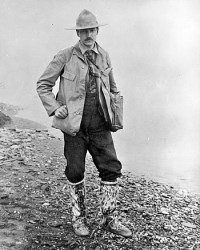
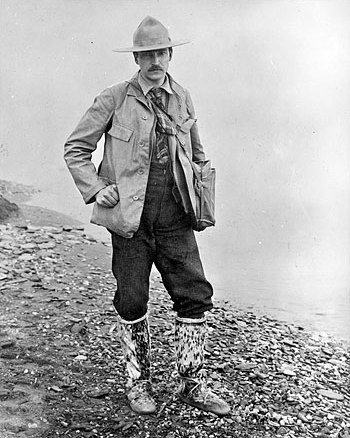
Source: Han Hwechin People of the River, C Mishler and W.E. SimeoneTappan

Adney, who camped and hunted with the Han Chief Isaac along the Klondike River during the gold rush, described his personality and behavior. Adney was a splendid artist as well as a fine writer. His many sketches of Isaac and his people give us a good sense not only of Isaac the man but also of the nomadic Han life in the Yukon backcountry. In his article 'Moose Hunting with the Tro-chu-tin," Adney reported that Isaac was a tall man who carried himself "with conscious self-respect" and had "a flashing eye that gave the impression both of mastery and shrewdness." Isaac would get up before daylight, step outside, and announce the day's activities. As Adney described: "He spoke not in the smooth, melodious tongue of the Eastern Indians, but slowly and deliberately, in short, crisp, incisive monosyllables. When he was done, he informed me in broken English that we were to hunt on the left-hand side of the river." From this description, it becomes clear that it was the chief's duty to give directions to the people for hunting and traveling. Undoubtedly, the chief's announcement also served as a general wakeup call. The fact that all the others were still in their tents at that hour of the morning pretty well precluded any questions or complaints. At the same time, Isaac is not remembered for being a bully, but for always talking politely to his followers.

Although most of the time he spoke Han, Isaac attempted to learn English as well, and his flavored speech of "short, crisp, incisive mono-syllables" evolved into a distinctive vernacular: "Mull moose, too much tupp; cow moose, plenty fat stop, he all right" meant that bull moose meat was too tough but cow moose meat was fat and tender. In Han and other Athabaskan languages there is no distinction between female and male pronouns, so it is common to hear Han speakers use "he" in place of "she" and vice-versa when they speak English.

Chief Isaac's Trip to San Fransisco

Source: ??????
One of the notable events in the life of Chief Isaac was a trip he took from Dawson to San Francisco in 1901 as a guest of the Alaska Commercial Company. This free trip was by steamboat to the mouth of the Yukon and then by steamship from St. Michael to Seattle and San Francisco Bay. Accompanying him, according to Louise Paul, were the lay reader Walter Benjamin and the Han medicine man Little Paul. Although he got seasick both ways, Isaac returned to Dawson standing on the Texas deck of the steamer 'Whitehorse', wearing a high hard hat, speckled knickers, a bright red tie with a sparkling pin, and sporting a big Havana cigar in his mouth. The newspapers reported that he was greeted by a crowd of thousands.

The following is from

THE MORNING SUN, DAWSON, WEDNESDAY, JULY 23, 1902

CHIEF ISAAC DUE TODAY

He Had a Grand Visit in Seattle.

INTERVIEWED IN THAT CITY

While White Men Have Killed the Business of the Indians in Trading, Fishing and Hunting He is Still Glad to Have Them in the Yukon.

It is stated that Chief Isaac will be back in Dawson today and that he will arrive on one of the mail steamers this morning.

The visit of Chief Isaac in Seattle has brought forth the following account of him and his people in the Post-intelligence of that city:

“While the coming of the white man have killed our business or trading, fishing and hunting, yet we are glad to have him on the Yukon.”

So spoke Isaac, chief of the Moosehides, a tribe once powerful and which had for ages occupied the Yukon. The noted red—for there is none other in all Alaska and the British Yukon so well known and so beloved both by the whites and natives—is in Seattle on his way north. Late in May he left Dawson, going down the Yukon, where at St. Micheal he took the steamship St. Paul for San Francisco. From this city he will return north Santa Ana, sailing today. The chief is accompanied by Walter Isaac, a younger brother. He is not an old man, only forty,yet he is wise in counsel and his influence with the Yukon Indians in undeniably great. The chief was born at the mouth of the famous Klondike. As a papoose strapped across his mother's back, he was carried all over the golden ground about Dawson. H wallowed in the auriferous sands and ate smoked salmon for food. Walter, ten years later, made his advent on the Yukon. He is an American by birth, for he first saw the light of day at Eagle City. The chief is British. But they are brothers in blood, if not in nationality. Both speak English. Walter better, perhaps, than his brother.

Isaac knows of his own knowledge that his father was chief by tradition that his ancestors were chiefs of the Moosehide for ages and ages. But of all the heads of the tribe there was probably not a greater man than the present chief. Certainly he is more advanced in civilization.

Chief Isaac left the Yukon on his present tour in quest of health and to better inform himself of the manner and methods of the up-to-date civilized man. He was threatened with consumption, but the trip has almost restored him to health. The Northern Commercial Company, the Alaska Commercial and the North American Transportation & Trading Company gave him transportation from Dawson to San Francisco and the latter transportation is entertaining him in this city and aiding him in his return to the Yukon. R,D. Snowden, manager of the latter company, is caring for the chief's comfort and entertainment here.

“I feel gratitude to the big companies,” he said, for what they have done for me. My health is much better and I have seen a great deal.”

Here the chief paused a moment and smilingly added: “Yes, I have seen so many strange and great things that I am tired now and want to return to my people.”

“The white man, it is true, drove our moose and other game back into the mountains out of our reach , but it is probably best for us. The cold of the earth is telling on us. Even the Moosehides can't stand that awful climate as they once could. They are dying off. My tribe now numbers but about 50 all told.”

“No, we have never mined. We don't believe in mining. Our pursuits have always been trading and hunting and fishing. Sometimes we mine for gold, but not often.”

On the streets of Seattle Chief Isaac met “Black Sullivan”. It was a joyous meeting. The two are great chums. “Black” Sullivan was one of the very first men on the Yukon. He, of course, came to know the chief well. In all the latter's travels he had seen no one with whom he was so well acquainted. Sullivan is a heavy Yukon operator. He resides in Seattle.

Captain Ferdinand Schmitter Account of the Chief

Source: ??????

Captain Ferdinand Schmitter of the Medical Corps who,during his term of duty at Fort Egbert, adjacent to Eagle had this to say about Chief Isaac. (Schmitter 1910) "Under their form of government the chief (ha-kkih) had despotic authority. He detailed hunting parties and dictated their duties, and when game was brought into camp he assumed charge of it, apportioning it out to whom he pleased. The chief of the Moosehide Indians near Dawson shows much of the pristine dignity and authority of his rank, and whenever he buys anything in Dawson he does not carry it home, but sends an Indian after it. He shows his genteel extraction by always wearing a pair of fancy decorated gauntlets when he goes on a several days' visit to Eagle during warm weather."

Tappan Adney's Description of a Traditional Camp

Source: The Han Indians-Cornelius Osgood
Tappan Adney's experience in January 1898 provides an excellent description of the portable skin dwelling used by the Klondike band of the Han.

Two miles from the Yukon, above the mouth of the Bonanza Creek, the head of the caravan stopped, and Isaac marked the place for the camp at the edge of the river, alongside a dense grove of spruce-trees. As we turned off the smooth miner's trail every person old enough to walk slipped into snow-shoes, as the snow was about two feet deep.

The women took long-handled wooden shovels and removed the snow off the ground an elliptical space eighteen feet long by twelve feet wide, banking it all around two feet high. While some covered the exposed river gravel with green spruce boughs and kindled a fire in the centre, others cut sticks three to five feet long and set them upright a foot apart in the bank of snow, the long way of the intended house, leaving an opening at one side two feet wide for the door.
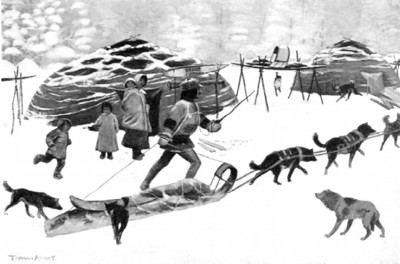
Traditional Camp
Traditional Camp
Source: The Indian Hunter of the Far Northwest - On the Trail to the Klondike
Tappan Adney, OUTING, Vol. XXXIX, No.6, March, 1902

The house-poles, an inch thick and ten or twelve feet long, whittled out of spruce and previously bent and seasoned into the form of a curve, were then set up in the snow at the ends of the camp to the number of sixteen or twenty, their upper ens pointing toward the middle in the form of a dome ten feet high. These were strengthened by two arched cross-poles underneath, the ends of which were lashed to the side-stakes with withes of willow twigs thawed out and made pliant over the fire. Over this comparatively stiff frame-work next was drawn a covering of caribou-skin, tanned with the hair on, made in two sections, and shaped and sewed together to fit the dome. The two sections, comprising forty skins, completely covered the house, except in the middle, where a large hole was left for the smoke to escape, and at the doorway, over which hung a piece of blanket.

The toboggans with the balance of the loads were hoisted upon pole scaffolds each side of the house, out of reach of the dogs, who looked and acted as if ready to devour anything from a moccasin to a rawhide toboggan-lashing.

Not until the house was done and enough wood stacked before the door to last until morning did any one stop for a moment. In a climate where the temperature remains not higher than thirty degrees below zero, and occasionally drops to fifty or sixty below, it is dangerous to dally, as white men are prone to do under the same conditions.
 In our little village there were seven lodges. In the chief's house were nine persons and seven dogs, divided into two households, each having a side of the fire to itself. On ours were Isaac, his wife Eliza, with a nursing boy less than a year old, myself, and three native dogs--Chicken (child), Gagul (broken leg), and John: also a tawny "whiteman's dog," Beaber, taken to board, a small black native pup, and an extremely miserable short-haired white man's pup, wrapped in a blanket to keep from freezing, and weighing just fourteen pounds by Isaac's spring scale. On the other side were a middle aged, stocky built man known as "Billy", or "the missionary's man," and his wife, with two girls respectively about eight and ten years of age, and a boy of the same uncertain age, four large native dogs and two pups. The human occupants kneeled or reclined before the fire, which was ingeniously built to throw the heat in two directions and to draw well, notwithstanding which latter, I soon discovered that it was often necessary to lie close to the ground, and when the smoke became too thick, to lift the lower edge of the skin covering.The following morning before daybreak word was given "All go." Toboggans were rattled off of caches, and house taken down and loaded as swiftly as they had been set up.

Chief Isaac Crosses the Great Divide

Source: Alaska Weekly, APRIL 15, 1932

Loved and Esteemed Yukon Indian Chief Was Honorary Member Yukon Order of Pioneers

Chief Isaac, Montezuma of the Klondike, was called to the happy hunting grounds last week. He breathed his last at the village of Moosehide, on the banks of the Yukon river three miles below Dawson, and his remains were recently laid away in the little Indian burial ground on the hillside overlooking the village.

Born some 85 years ago, Isaac was elected chief as a young man, and through many years of trial before and after the coming of the whiteman, proved his worthiness for the honor and trust imposed in him by his people.

Tall, slender, sinewy and muscular, he was of superior physical proportions, and time also proved him as well endowed mentally. His friendliness to the whites, dating back to the days of the Russian occupation of the Yukon and Alaska, and his influence with other Indians, went far toward smoothing the way for prospectors, traders, trappers, missionaries and others who pioneered the Northland. Those who knew Chief Isaac well agree, that, had he been a white man with opportunities for education, combined with his natural ability and personality, he would have proved to be an extraordinary figure in most any walk of life.

Camped On Untold Wealth

The Moosehide tribe, of which the chief was the head for many decades, held by inheritance all the interior area of Yukon between the Fortymile and the Stewart rivers. This area included the world famed valley of the Klondike and its wondrous network of gold-bearing creeks which yielded to the world a quarter billion dollars or more in gold and are still producing at the rate of a million dollars per annum.

The chief, like all other members of his tribe, was a devout member of the Church of England. He was a faithful attendant at services in the little church at Moosehide-founded by Rev. Archdeacon MacDonald, translator of the Bible into the Takudth Indian language, which is the language of the Moosehide tribe. The Rev. Totty and Bishop Bompass, also were identified with the little church through many years since it was established.

For centuries all of the wealth of the Klondike lay within the radius of a days hike from the home of Chief Isaac and his people, yet, endowed with the wealth equal to the ransom of a score of kings, they knew not of its existence or its value until the white man came. The Indians practically gained nothing from that great store of golden treasure and even after the strike they lived the simple life of the native within the shadow of the great gold camp and Dawson it's capitol city.

Isaac was made honorary member of the Yukon Order of Pioneers some years ago, and on Discovery and other celebration days always accorded a place of honor at the head of the various pioneer parades and sat with the big white tillicums at the banquet board. He was a great chief...and although his skin was red, his heart was white--and not a sourdough of that vast throng who passed his way fails to hold a kindly thought for him today, and silently and sincerely say unto themselves, "he was a friend to the whites in a far land...what's more he was every inch a man."

Chief Isaac leaves two sons and two daughters to mourn his loss. One of his sons will possibly be made chief in his stead. At present time there is quite an epidemis of influenza among the Indians along the upper Yukon. Chief Isaac was a victim of that dread malady.

Isaac fought for Canada, and the Tr’ondek

Source: Yukon New - Wednesday November 10, 2010, By Joy Isaac

Charlie Isaac was born November 25, 1912, in Moosehide Village, a short distance downstream of Dawson City. He was the son of the beloved Chief Isaac and his wife Eliza. Chief Issac led his people through the upheaval of the Gold Rush and passed away in 1932. Charlie succeeded his father as chief of the Han Nation (Tr’ondek Hwech’in) when he was 20. When the Second World War began, Charlie handed over his role as chief to a council of elders and headed to Vancouver in 1941 to join the army and fight for his country. He was accompanied by George Walters.

Charlie Isaac, Italy 1944

While stationed at the old Hotel Vancouver barracks in April 1942, and after graduating in motor mechanics at the Vancouver Trade School, Charlie reported he’d met up with a happy crowd of Yukon soldiers enjoying the sunshine in front of the old hotel, including Sapper Charlie Ross, privates George Maddocks, Henry Siemers, Axel Nordling, Ian Aldcroft, Otto Nordling, Alan Gould, and corporals Tommy Rodgers and Dan Olds.

Soon Charlie found himself with an artillery regiment on Vancouver Island and taking a signaling course in Victoria. “I didn’t like the artillery guns,” he said. “They were pretty big and sure hard on your ear drums. I joined the Royal Canadian Ordnance Corps in 1942 and went back east.” After training, he was sent overseas and served as an ammunition bearer, seeing a lot of action on fronts throughout Europe. He slept in English cottages, French inns, Dutch cots or Italian vineyards. “We used to lie down and go to sleep between the rows of grapes in the vineyards,” Charlie said. “All around us would be a cloak of grapes. The Germans used to put poison in the wine vats, which were huge, great things. The Canadians used to test the wine by letting a cat drink it first.”

Charlie’s wartime and other stories were featured in the article Civilization? Take it Away by Stuart Gray in The Vancouver Province, December 20, 1966.

When the war ended in 1945, Charlie returned home to Yukon and carried on as chief, devoting his time to working with government to improve the condition of his people. He had a great sense of humour and, more than once, told government officials the government had stolen the land from his people and he had gone to war to save the land for them. His 200 member band was moved from Moosehide village so they could be supplied with modern homes, electricity and running water. However, Charlie preferred to drink mountain creek water and decided to move back to the old village and share the solitude with his older brother Fred.

Charlie’s health eventually deteriorated from an overseas bout with malaria. He also suffered from a serious arthritic condition which was probably caused from lying in one too many muddied battlefield ditches while serving overseas. The war years eventually took its toll and Charlie moved to George Derby Veterans Centre in Burnaby where he passed away suddenly on February 25, 1975, at the age of 63. He was laid to rest in cemetery above Dawson City. Charlie was adored by many people in his village and will always be missed by family.

Charlie’s medals include the 39-45 Star, Italy Star, France and German Star, Defense Metal and Volunteer Service Medal and clasp. Joy Isaac is the niece of Charlie Isaac.

Charlie Isaac Went To War - Served All Over Europe

Source: The Whitehorse Star, Thursday, November 10, 1977

Late in 1941, Charlie Isaac, who had succeeded his father as Chief of the Moosehide Indians ten years before, handed over the tribe to a council of elders and quit his job with White Pass to go to war.

Accompanied by George Walters, he joined the Army in Vancouver and found himself with an artillery regiment on Vancouver Island, taking a signalling course in Victoria.

But, he said, "I didn't like the artillery guns. They were pretty big and sure hard on your ear drums. I joined the Royal Canadian Ordinance Corps in 1942 and went back East."
Charlie Isaac, Vanouver, 23 March 1942
First he spent several months in Vancouver, stationed at the old Hotel Vancouver barracks and training in motor mechanics at the Vancouver Trade School. Graduating in April, Charlie met up with a happy crowd of Yukon soldiers enjoying the sunshine in front of the old hotel.

There was Sapper Charlie Ross, who had just returned from six months at York Island; Private George Maddocks of the Royal Canadian Army Medical Corps attached to Shaughnessy Hospital in Vancouver; Privates Henry Siemers, distinguished by his number K-1000000, Axel Nordling and Ian Aldcroft enroute to training camp; Privates Otto Nordling and Alan Gould of the Hotel Vancouver barracks staff, Corporal Tommy Rodgers, based at Stanley Park and Dan Olds who had just received his discharge.

From Aldershot, England, Charlie served as an ammunition-bearer all over Europe and in Italy of which he wrote, "We used to lie down and go to sleep between the rows of grapes in the vineyards. All around us would be a cloak of grapes. The Germans used to put poison in the wine vats, which were huge, great things. The Canadians used to test the wine by letting a cat drink it first."

He spent two Christmases in Italy, joining the other homesick Canadians in singing, to "White Christmas."

Charlie's wartime and other stories were featured in an article "Civilization? Take it Away" by Stuart Gray in The Vancouver Province (Dec.20,1966 carried by the Whitehorse Star on the 22nd).

It was read by General J.V. Allard, Canadian Forces Headquarters Ottawa who wrote Charlie a personal note.

It read, in part, "Your a real credit to Canada and an inspiration to your tribe; I salute you and pray to God that he keep you for many years to come..."

Civilization? Take it Away!

Source: By Stuart Gray, Vancouver Province, December 20, 1966

Chief Charlie Isaac leaned forward on the chair 735 miles from home and smiled. "If I met some of the long haired people from Robson Street in the bush up north," he said, "I'd run. That is, unless I carried a tomohawk."

Home for Charlie, 56 year old head of the Moosehide Band from Dawson City in the Yukon, is a cabin in the deserted village of Moosehide, two rugged miles from Dawson. His 200 band members moved from the village when the Federal government supplied them with modern homes, electricity and running water. But Charlie is an individualist. He's content to drink mountain creek water, stoke the fire with pine wood, and share the solitude of the forest with his older brother Fred, 64.

Right now he's staying in New Westminster for a few weeks while being treated for arthritis as an outpatient at Shaughnessy Hospital. With the evening rain battering the roof of his boarding house, and still half-an-hour until bedtime, he shifted his chair and settled back.

At first glance, Charlie seems just an ordinary chief, with erect bearing, finely hewn features, and wise eyes-the usual chieftain qualities. His air of authenticity deepens when he tells of setting traps at the age of 12, or of wolves that prowl around his cabin in winter. This picture soon shatters. Chiefs aren't usually expected to have a spontaneous sense of humor that erupts every other sentence.

They aren't expected to have been overseas during the Second World War, and to have slept in English cottages, French inns, Dutch cots, or Italian vineyards. They aren't usually regarded as confirmed bachelors with erudite opinions on modern social structures. This, however, is Charlie; humorist, war veteran, and philosopher, who chose to live in the bush just as generations did before him.

He began trapping with his father in 1922, and was skilled in woodlore before the elder Isaac decided another sort of skill was needed. "I didn't want to go to school, but my father made me," Charlie said. "As it turned out, I did five years of school in three. Then I left school and went back to trapping with my father."

Charlie trapped for another dozen years, during which time he became a confirmed bachelor. Then, with his parents dead and no dependents, he left Moosehide to join the army and see the world.

The artillery regiment on Vancouver Island was happy to accept the strapping young chief, but Charlie became unhappy with the regiment. "I didn't like the artillery guns. They were pretty big, and sure hard on your ear drums. I joined the Royal Canadian Ordinance Corps in1942 and went back East."

During the next three years, he criss-crossed Europe, and saw action on many fronts as an ammunition bearer. More than one hard-pressed machine gunner in the heat of battle was startled to receive his clips from a real Indian wearing Ordinance flashes.

Two Christmas Days of the war were spent by Charlie in Italy, one of his favorite countries. He recalls some unusual sleeping accommodation. "We used to lie down and go to sleep between rows of grapes in the vineyards. All around us would be a cloak of grapes." The abundance of grapes--and wine--sometimes provided an opportunity for intrigue. "The Germans used to put poison in the vats, which were huge, great things. The Canadians used to test the wine by letting a cat drink it first."

After the war, Charlie landed in Halifax, where he was greeted by a bevy of pretty girls bearing flowers and candy. He lost no time in getting back up north.

Although he hasn't trapped since the war, he regularly walks the two miles into Dawson for exercise. He is still well-known to members of his rapidly-growing tribe. "Even the little kids come up and call me chief. There are so many of them, I scratch my head." Shopping and visiting over, Charlie returns to his cabin. "On a cold night with strong moonlight, you can look out and watch the wolves howl."

Dawson Daily News Accounts

1897-After Chief Isaac negotiated with government and church officials, the Tro'ndek Hwech'in moved downriver to Moosehide. They built cabins for missionary and themselves.

1902-Chief Isaac travels Outside on a trip to visit various major coastal cities sponsored by the major trading companies. Chief Isaac and his brother Walter are the guest of the three major trading companies on a trip to San Francisco. They travel downriver on steamer Sarah.

1913-"Young Prince of Moosehide Off To School." Fred Isaac and 7 other Moosehide children leave for school in Carcross.

1922-Young Charlie Isaac began trapping with his father and was skilled in woodlore before the elder Isaac decided another sort of skill was needed. "I didn't want to go to school, but my father made me," Charlie said. "As it turned out, I did five years of school in three at Carcross. Then I left school and went back to trapping with my father."

June 22, 1926- Big Chief is Back from Selkirk
Chief Isaac, powerful Montezuma of the North returned by small boat on Thursday afternoon from Selkirk, where he had been paying a visit during the last three weeks. Bronzed and rugged looking from his vacation out in the open, the big chief is in pink of condition. The Chief said that everybody was glad to see him in Selkirk. He said that the white men and the Indians shook hands with him. He said that all had a big time.

On the way down the river Isaac stopped off at Coffee Creek, where another big potlatch was held among the Indians at that point. The chief also bagged two moose and stopped at several other places while on his way down the river. Chief Isaac was accompanied on his jaunt to Selkirk by Johnathon Wood and Esau Harper.

1932-death of Chief Isaac during influenza epidemic.

1938-Death of Johnathan Wood, brother of Chief Isaac, described as "easily the oldest Yukon Indian resident at Moosehide" (Jan. 6,1938)

1939-outbreak of World War 11. Eventually a number of Yukon First Nations enlist to serve overseas including Charlie Isaac, son of Chief Isaac. George Walters left Dawson City a month after Charlie Isaac, joining the Canadian Forestry Corps.

1942-Charlie Isaac, "young chief of the Moosehide braves" recently transferred from Victoria. Will be stationed in Vancouver while studying mechanics. In Victoria, took a course in signalling and finished with flying colours.
Christmas Greetings from Charlie Isaac, December 24, 1970, The Whitehorse Star

Dear Editor, Whitehorse Star
Will you please put this in your paper for me for Christmas?
To all my friends and church people in the Yukon..I am now in Sunset Home at Dawson City I cannot send you a card as I can't afford, but will remember you all for Christmas and happy New Year. May God be with you. I am enclosing my photo which was taken in England in 1943 in Aldershot, and will write you the song the soldiers sang in Italy and Sicily for Christmas (to the tune of White Christmas)
I'm dreaming of a fifth Christmas, just like the other bloody four..
Where the rain drops patter, and eyeties chatter
It makes you wonder more and more.
I'm dreaming of a fifth Christmas,
Though Christmas cards I cannot write
Still I hope and pray every night
That with luck, my sixth Christmas will be white.
.......Charlie Isaac